This blog is about art with an archangel as well as art for an archangel, my son Gabriel. Most, if not all of the arts & crafts I will blog about are in essence for my son. Crafting & art at an early age not only stimulates creativity but also teaches a child how to use many of his fine motor skills. Fine motor skills are movements that use the small muscles of the fingers, toes, wrists, lips, & tongue. These are extremely important in his development.
Some motor skills take some practice to achieve &
learning how to button is one of the more difficult ones. In order to
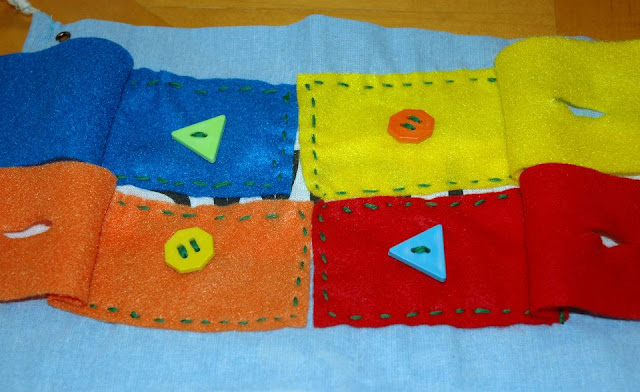
assist Gabriel, I created this colorful, fun little felt button
exercise. I re-used a linen bag that came with shoes as the base which
made it useful two-fold; one as the button exercise & two, as a
carry bag. We keep small, quiet puzzles & busy things in there for
church.
Materials:
Felt sheets
Buttons
Needle & Thread
Easy to do- just cut the felt into equal-sized squares... Create button-holes on one piece & sew the buttons on!
We love paint. And there is so much that can be explored with it...
While painting hand-over-hand with Gabriel we saw how lovely a
splayed/spread-out paintbrush looks! So then we began experimenting with
different colors & different amounts of paint on the brush... These
are the nicest from the art lesson.
I can feel it coming... summertime. And I am so happy... weekend drives down the shore, to the beach, trips to the zoo, the aquarium, to the amusement parks...Ahhhh... Time for summer themed crafting...
Start with large foam crabs
& googly eyes...
a small bowl of salt +
a couple of drops of food coloring...
mix it together well & allow it to DRY (your fingers will get stained if not!)
Take a sheet of colored paper
& spread some school glue where you want your "colored sand" (salt)...
Sprinkle the colored salt onto the glue
& allow to dry...
When dry, carefully lift the paper & discard the excess salt over a trash bin...
Affix the googly-eyed crab to the scene with school glue.
There's a great article from the Examiner on why puzzles are good for children. Key points:
Puzzles build hand eye coordination
Puzzles develop fine motor skills
Puzzles offer opportunities for social and language skills
Puzzles encourage problem solving and logical thinking
MATERIALS: All you need is a puzzle (we have a few of the kind that come in a baggie instead of a box):
& self-adhesive craft magnets like these below. I love these because they are easy to cut with scissors & they are thin. They also adhere well.
Turn all of the pieces over.
Adhere one magnet to the center of each piece:
And you are ready to put together the puzzle on any magnetic surface... the refrigerator, dishwasher... washing machine (keeps kids busy!) or on a magnetic lapboard (great busy time in the car! No pieces lost.)
See the Beatles magnet, upper left-hand corner? Gabriel knows all 4 Beatles' names since he was one! Now it is "his" magnet.
I chose this as my inaugural post because it sums up this
blog- it is about art with an archangel as well as art for an archangel, my son
Gabriel. Most, if not all of the arts & crafts I will blog about are in
essence for my son. Crafting & art at an early age not only stimulates
creativity but also teaches a child how to use many of his fine motor skills.
Fine motor skills are movements that use the small muscles of the fingers,
toes, wrists, lips, & tongue. These are extremely important in his development.
This project- a weighted sensory pillow- was important to me
because it also helps with his proprioceptive senses (A sensory receptor, found
chiefly in muscles, tendons, joints, & the inner ear, that detects the
motion or position of the body or a limb by responding to stimuli arising
within the organism). If your child has sensory issues for any reason (Sensory
Processing Disorder (SPD), an Autism, Autism Spectrum Disorder (ASD), ADHD
& other neurological disorders, or even simply issues with sleeping…) you
may want to consider a weighted pillow or blanket. Based on the sensory integration
technique of deep pressure providing the child with unconscious information
from the muscles & the joints, the added weight or pressure may help the
child calm down and better integrate sensory information. As a result, the
child may become more organized, & improve in their ability to concentrate
on play, learning or eating.
These
items (weighted pillow & blankets) are extremely expensive so I decided to
make my own… And he manifested in the form of Monkey Face:
How to create a weighted pillow from an existing pillow form:
Buy a small animal pillow, or a stuffed animal that can lay flat
across a lap (like a pillow pet), or on a sleeping chest. Like Monkey-Face:
Next, find a seam on the side bottom (pictured) or side & carefully tear it
open about six" long.
I had to take out half of the original stuffing (use your judgment)... Then I inserted only 2lbs of Poly Pellets.
Suggested weight is 10% of their body weight + 1
pound.
BUT I didn't want it too heavy (Gabriel's 32 lbs, which would mean a 4+lb pillow)
Distribute the pellets into the body of the
stuffed animal guiding them into place. Then, with double thread, sew the seam
back up well. I also took off the pink, decorative hair-flower above Monkey-Face's right ear & replaced it with a hand-sewn orange "G" for Gabriel:
I hope you will enjoy reading my blog as much as I love to
make the crafts & share my excitement with Gabriel.
I also hope you will come back & visit!
Please, if you have a moment to lollygag, stroll on over to
DeLish, my food blog.